
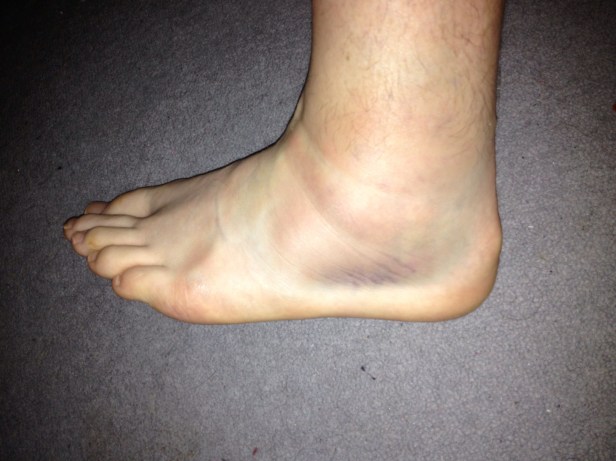
Whilst marking part of the hilly Hundred Hills 50k, I managed to roll my ankle. On the wrong side of a camber. And of course I was approximately half way between where I was starting and where I was finishing. With absolute shock and agony I surprised myself at how loudly I screamed out. I spent a few minutes hobbling around frustrated at the situation and cursing my luck.
I made the decision to carry on, BUT, if I was able to stop right there and then I would have. Limiting impact and use after an injury should be your highest priority.
When I finished marking, the ankle was visibly swollen but not bruised. I was hoping it wasn’t anything.
So, to recap I’ve made two mistakes straight away
- I continued to run on the injury, where I could have considered asking for assistance
- I then hoped for the best, which set my mindset to ‘Ah, it’ll be alright’
What I did get right
- When I got home I reached for an ice pack, I set some pillows up under my feet in bed, and got some good rest. R.I.C.E is the best recommendation after an injury
- I then also accepted that I wouldn’t be running the next day
But then why did I go for a run a few days later?
I didn’t go for a run the day after I rolled the ankle (Friday), but I did on the Monday. I wanted to test it out. And whilst it wasn’t great, I reconciled with myself that I wasn’t doing my usual fast pace Monday. So that was fine. A gentle base run wouldn’t hurt anyone, right?
Wrong. Of course. Because I had set myself up with a ‘Ah, it’ll be alright’ mentality’. Eager to keep running in the good weather, and with my North Downs Way 50 goal clear in my mind, I was able to convince myself that running on an injury was fine. As long as I took it carefully and slowly I’d be getting fitter, right? Reader, no. I am an idiot.
Take a breath, and think about what advice you would give to others
We all love giving a bit of advice. “Ooh, I wouldn’t have done that”, “I’d have…”, “I’d say…”, etc. And whilst much of our advice is just an opinion (and mine is mostly tosh), using this as a tool for checking what you’re about to do is highly recommended.
If your friend had a visibly painful injury and was about to go for a run, you’d probably question the decision. Or warn them against it. Or provide them with guidance on what might be a better approach. Or call them an idiot. If you didn’t, you wouldn’t be much of a friend.
So I did that. I reasoned with myself and recommended that I take a week off. And I did. It was great. I got a lot of stretching in. I had extra time to reflect on the injury. I still got out for a few light walks and a light bike ride. And then when I came to test my legs again they were in much better shape. And, it didn’t really affect my training as much as I thought it would.
The next stage is crucial of course. If the injury comes back, will I be strong enough to keep off of it as the starting line looms? It’s not easy, but rest is better than making any injury worse.
Hope this helps.
 Simply Seanie